
Last Updated: November 1, 2026
Quick Summary
Safe behavioral tools for anxious pets include quiet beds, enrichment toys, and calming wraps, chosen to fit your pet’s species, health, and severity of distress. Screen each product for choking, fit, overheating, and ingredient risks before buying. Behavioral tools work best alongside a predictable routine and gradual desensitization, and any tool that worsens stress should be removed.
- Stop any tool that causes increased stress, refusal, vomiting, lethargy, or labored breathing.
- Match aids to severity: mild distress starts with routine and a quiet den, moderate adds a pressure wrap.
- Severe separation distress needs veterinary care and a behaviorist referral, not more products.
- Track behavior for two to four weeks after starting a new tool to judge whether it helps.
- Check supplement and spray labels with your veterinarian, especially if your pet takes prescription medication.
Table of Contents
- Why Pets Become Anxious and How to Spot the Signs
- Screening Calming Products for Safety Before You Buy
- Environmental Tools: Safe Spaces, Calming Beds, and Predictable Routines
- Enrichment Toys for Anxious Dogs and Cats
- Calming Aids for Dogs with Separation Anxiety
- Step-by-Step Desensitization and Counterconditioning at Home
- How to Tell If a Tool Is Working and When to Call Your Vet
- Frequently Asked Questions
Anxious pets are more common than most owners realize. At Bestie Pets Plus, we’ve put together this guide to help you choose behavioral tools that are safe, practical, and worth your money.
A behavioral tool is any product or setup that helps a pet feel calmer, safer, or more in control of its surroundings. Some are simple, like a quiet bed.
Why Pets Become Anxious and How to Spot the Signs
Anxiety usually has a trigger, and the trigger often shows up in a predictable pattern. Learning the pattern is the first step toward picking the right tool.
Common triggers: noise, separation, and changes in routine
The most common triggers are loud sounds, being left alone, and sudden changes at home. Thunderstorms, fireworks, moving furniture, new visitors, and a change in work schedule can all set off a reaction.
- Noise: Storms, fireworks, vacuums, and construction
- Separation: Being left alone for long stretches
- Routine changes: New pets, moves, or a shift in feeding times
Distress behaviors to watch for in dogs, cats, and small animals
Distress looks different in each species. A dog may pace or bark, while a cat may hide or stop eating. Small animals like rabbits and guinea pigs often freeze or go quiet, which owners can miss.
- Dogs: Pacing, panting, whining, destructive chewing, or house soiling
- Cats: Hiding, over-grooming, litter box changes, or vocalizing at night
- Small animals: Freezing, hiding, reduced eating, or thumping
Screening Calming Products for Safety Before You Buy
A calming tool is only safe if it fits your pet, your pet’s species, and your pet’s current health status, and if you know the specific failure mode to watch for. Use the screen below before you buy, and again after the first week of use.
Product-specific risks to check before purchase
- Choking and ingestion risk (toys, lick mats, puzzle feeders): Look for toys sized so the pet cannot swallow the whole piece, and avoid rope, string, or small removable parts on pets who shred. Lick mats and puzzle feeders should be inspected for cracks and bite-through after every use; discard any tool with exposed foam, loose suction cups, or torn silicone.
- Fit and pressure risk (wraps, harnesses, crates, playpens): A calming wrap should be snug enough to feel like gentle pressure but loose enough to slip two fingers under the edge. Check for rubbing at the armpits, restricted breathing, or a pet who freezes or refuses to move when wrapped. Crates and playpens need a latched door, no sharp wire ends, and no collar or tag that can catch on a bar.
- Overheating risk (beds, tents, enclosed spaces): Enclosed cat tents, hooded beds, and covered crates trap heat. A pet who pants, drools, or seeks the floor after using an enclosed bed may be too warm. Avoid covered or plush enclosures for brachycephalic breeds (flat-faced dogs and cats), pets with heavy coats, and any pet in a room above normal household temperature.
Questions to ask before you buy
- Does the label list every ingredient and every material, or only the marketing claims?
- Is the product sized for your pet’s species and weight, not just “small” or “large”?
- Does the manufacturer publish a return policy and a contact for safety questions?
Stop using any tool immediately if you see increased stress, refusal to approach the tool, vomiting, lethargy, drooling, labored breathing, or a new behavior that appeared after you introduced it. A tool that makes anxiety worse is not a training problem, it is a signal to remove the tool and call your veterinarian.
When to stop using a tool
A safe tool should be neutral or better within the first week. Stop and reassess if your pet avoids the bed, hides from the wrap, guards the puzzle feeder, or shows any of the distress signs above. For supplements and sprays, stop at the first sign of GI upset, itching, or respiratory irritation and contact your veterinarian.
FDA Center for Veterinary Medicine, reporting an adverse event or product problem
Environmental Tools: Safe Spaces, Calming Beds, and Predictable Routines
A calm environment is often the easiest place to start. For a visible, low-light option that also helps with evening walks, see the LED rechargeable pet collar.
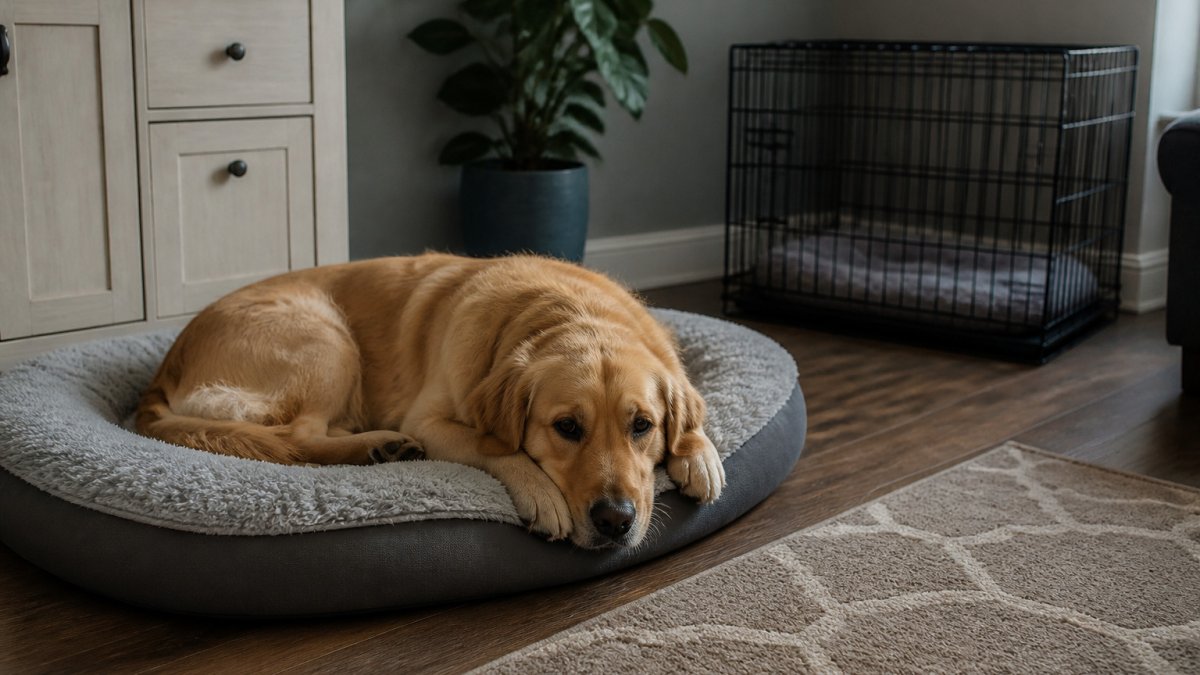
!A golden retriever resting on a soft calming bed in a quiet corner of a living room, with a closed crate and a low-lit room nearby
Try these basics:
- Set a bed or crate in a quiet area away from doors and noise
- Keep feeding, walks, and bedtime at the same times each day
- Use a white noise machine or soft music to mask sudden sounds
For pets that need extra space, a portable mesh safety fence can create a secure area without closing them into a crate.
Enrichment Toys for Anxious Dogs and Cats
Enrichment toys give anxious pets something to focus on. A pet busy with a puzzle is less likely to dwell on a noise or a sudden change.
Good options include:
- Food-dispensing toys: These release kibble as the pet works at them.
- Lick mats: Spread wet food or a calming treat across the surface.
- Puzzle feeders: These slow down eating and add mental work.
Start with easy versions and increase the difficulty slowly. A pet who gets frustrated may need a simpler toy for a while.
Birds and other small pets can benefit from enrichment too. Foraging toys and chew items give them a healthy outlet and a way to stay busy.
Calming Aids for Dogs with Separation Anxiety
Separation anxiety is not one problem, so no single calming aid fits every case. The ranking guides tend to present an undifferentiated product list; this section instead matches aids to the severity and pattern of the distress, and it extends the guidance to cats, who also show separation-related behavior. Use the tiers below to decide where to start, and pair every aid with the desensitization plan in the next section.
Match the aid to the severity
- Mild distress (whining, pacing, settling within 10-15 minutes): Start with environmental tools, a predictable departure routine, a quiet den, a food-dispensing toy or frozen lick mat given right before you leave, and a familiar-scented blanket. These are low-risk and often enough for a pet who recovers quickly.
- Moderate distress (barking, chewing, house soiling, recovery taking 30 minutes or more): Add a calming wrap or pressure garment, a pheromone diffuser in the pet’s main room, and a structured desensitization plan with very short absences.
- Severe distress (escape attempts, destructive behavior at exits, self-injury, vocalizing for the full absence): These cases need veterinary involvement. A veterinarian can rule out medical causes, discuss prescription medication, and refer to a veterinary behaviorist. Calming beds and sprays are not a substitute for treatment at this level, and leaving a severely affected pet alone for long stretches while trying products one by one can deepen the fear.
Species-specific notes
- Dogs: Pressure wraps and pheromone products are the most commonly used aids. Introduce a wrap during a calm moment, pair it with a treat, and remove it if the dog freezes or tries to bite at it.
- Cats: Cats with separation-related distress often hide, over-groom, or vocalize after an owner leaves. A covered cat tent bed, a pheromone diffuser, and a timed feeder or puzzle toy can reduce the empty-house effect. Cats are sensitive to scent and surface changes, so introduce one aid at a time and keep the cat’s core territory stable.
- Small animals and birds: Rabbits, guinea pigs, and birds can show distress when a companion or routine changes. Foraging toys, chew items, and a covered retreat are lower-risk starting points than sprays or supplements, and any dietary supplement should be cleared with a veterinarian who treats that species.
What the evidence supports, and what it does not
Calming treats and supplements vary widely in formulation, so check label ingredients and doses with your veterinarian before use. No product replaces a gradual absence plan.
Choose the lowest-risk aid that matches your pet’s severity tier, introduce it during a calm moment, and keep a behavior log. If distress does not improve within two to four weeks of consistent training plus the aid, escalate to your veterinarian rather than adding more products.
American Veterinary Society of Animal Behavior, position statements on behavior and medication
The article sorts separation-anxiety aids by how severe the distress is, so you can start with the lowest-risk option that fits.
| Distress level | Signs | Suggested starting aids |
|---|---|---|
| Mild | Whining, pacing, settles in 10-15 min | Routine, quiet den, food toy, scented blanket |
| Moderate | Barking, chewing, house soiling, 30+ min recovery | Pressure wrap, pheromone diffuser, short-absence plan |
| Severe | Escape attempts, self-injury, full-absence vocalizing | Veterinary care and behaviorist referral |
Step-by-Step Desensitization and Counterconditioning at Home
Desensitization and counterconditioning help a pet feel less afraid of a trigger over time. The goal is to pair the trigger with something positive, while keeping the pet below the level that causes fear.
Follow these steps:
- Identify the trigger. Note exactly what sets off your pet.
- Start at a low level. Use a quiet version, such as a recording of thunder at low volume.
- Pair with a reward. Offer a favorite treat or toy while the trigger is present.
- Increase slowly. Raise the volume or intensity only after your pet stays calm.
- Stop if fear returns. Go back to the last level that worked.
Progress can be slow. Expect setbacks, and keep sessions short. Punishment has no place in this process, since it can deepen fear and damage trust.
How to Tell If a Tool Is Working and When to Call Your Vet
Track your pet’s behavior for two to four weeks after starting a new tool. Note how often the anxiety shows up, how long it lasts, and how quickly your pet recovers. A tool that works should lead to fewer episodes or faster calming over time.
Watch for these signs that a tool is not working or may be causing harm:
- Stress gets worse after using it
- Your pet refuses to use a bed, toy, or crate
- New symptoms appear, such as vomiting or lethargy
Call your veterinarian if anxiety is severe, lasts a long time, or affects eating, sleeping, or safety. A vet can rule out medical causes and recommend a treatment plan. Some pets benefit from a referral to a veterinary behaviorist.
Choose tools carefully, go slowly, and keep your pet’s comfort first. We hope this guide helps you find the right fit.
Frequently Asked Questions
What are safe ways to calm an anxious pet?
Start with low-cost, low-risk changes: a quiet safe space with a bed or crate, a predictable daily routine, regular exercise, and food-dispensing toys or lick mats that give the pet something to focus on. Pheromone products and calming wraps are commonly used alongside these, but results vary by animal. Avoid punishment, which veterinary behavior guidance consistently says deepens fear rather than resolving anxiety. If anxiety is severe or getting worse, check with a veterinarian before adding any supplement or medication.
Which calming tools can help dogs with separation anxiety?
Calming aids for dogs with separation anxiety often include a comfortable crate or playpen set up in a quiet room, a worn piece of clothing that carries your scent, and food-dispensing toys that keep the dog busy while alone. Practicing short departures and gradually increasing them is usually more effective than any single product. Because separation anxiety can be persistent, combining behavior work with veterinary guidance tends to produce better results than relying on products alone.
Do calming products work for anxious pets?
Evidence varies by product and by animal. Environmental changes and enrichment have the most consistent support in behavior guidance, while pheromone sprays, wraps, and supplements show mixed results across individual pets. Track your pet’s behavior for two to four weeks after introducing a tool to judge whether it makes a meaningful difference.
How can I tell whether my pet’s anxiety needs veterinary care?
Contact a veterinarian if anxiety causes self-injury, destructive behavior that continues for days, loss of appetite, house soiling, excessive panting or drooling, or a sudden change in behavior. Anxiety can also be linked to medical problems, so a vet exam helps rule out pain or illness. A professional plan may be the right next step.






0 Comments