
Last Updated: October 28, 2026
Quick Summary
The best bird enrichment toys combine foraging, shredding and chewing, and interaction, matched to your bird’s size and beak strength. Human interaction ranks as the enrichment birds seem to prefer most, and food-based toys and destructible toys follow close behind. Choose safe materials like untreated wood, undyed natural fiber, and stainless steel hardware.
- Human interaction ranks as the enrichment birds seem to prefer most, per a recent survey.
- Food-based enrichment and destructible toys followed close behind in that survey.
- Match toy hardness to bird size band and beak type, not color or shape.
- Avoid zinc-coated or galvanized hardware, lead weights, and painted or varnished wood.
- Rotate two or three toys weekly to keep your bird’s interest high.
Table of Contents
- Why Bird Enrichment Toys Matter for Your Bird’s Daily Life
- Bird Foraging Toys That Keep Your Bird Busy
- Shreddable and Chewable Toys by Bird Size
- Checking Safe Bird Toys for Materials and Hazards
- How to Make DIY Bird Toys at Home
- Rotating Bird Toys to Keep Interest High
- Choosing Your Next Bird Toy With Bestie Pets Plus
- Frequently Asked Questions
Why Bird Enrichment Toys Matter for Your Bird’s Daily Life
Human interaction ranks as the enrichment birds seem to prefer most, according to a recent survey published in the Journal of Applied Animal Welfare Science A Survey of Environmental Enrichment Practices in pet birds, Journal of Applied Animal Welfare Science. Food-based enrichment and destructible toys followed close behind in that same survey. For most owners, that finding points to a simple idea: a bird with something to do is a calmer, healthier companion.
Enrichment can include foraging, chewing and shredding, interaction, and changing toys. A toy may cover one or more of these activities.
Boredom is the problem enrichment solves. A bird left alone in a bare cage has little to explore, so it may pluck feathers, screech, or pace. Toys do not fix every behavior issue, but they give the bird a productive outlet.
Bird Foraging Toys That Keep Your Bird Busy
Foraging toys ask a bird to work for its food. Treat cages, vine balls, and puzzle toys hide small rewards that the bird must dig out, which turns mealtime into play. Survey respondents and product guides both rank food-based enrichment near the top, so this category deserves a spot in nearly every cage.
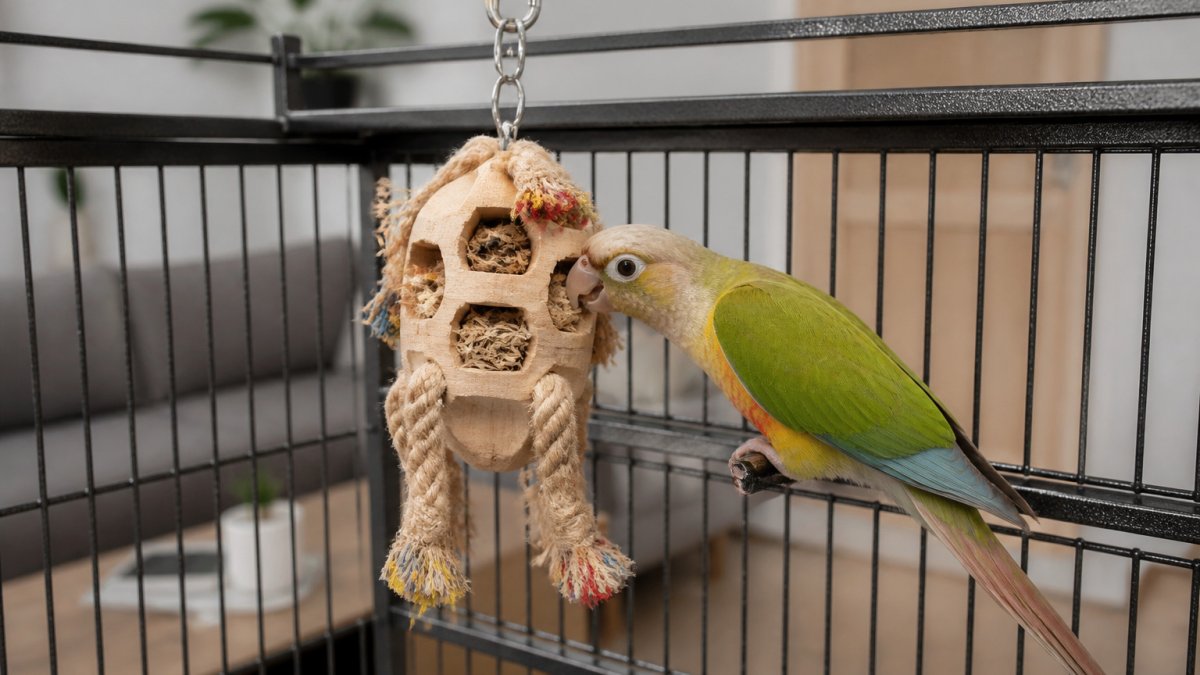
Our practical pick here is a rotating treat toy. It keeps the bird engaged longer than a simple hanging treat, and it fits the foraging theme without much setup. You can find one in our bird enrichment toy collection, and you can explore a rotating parrot treat toy if you want to start with a single item.
Watch out: Never fill a foraging toy with sugary or salty treats. Stick to bird-safe options like small pieces of vegetables, plain seeds, or approved millet sprays.
Shreddable and Chewable Toys by Bird Size
Shredding is one of the most natural behaviors a bird can perform. Paper, soft wood, and natural fibers give the beak something to work on, and they wear down over time as the bird chews. The mistake most owners make is buying by color and shape instead of by beak strength and body scale. A toy that lasts a budgie a month can be destroyed by a macaw in an afternoon, and a toy built for a macaw can be physically unsafe for a cockatiel.
Use the bird’s weight and beak type as your first filter, then match material hardness to how the bird actually chews.
| Bird size band | Typical examples | Beak profile | Best shred/chew materials | What to avoid |
|---|---|---|---|---|
| Small (under ~30 g) | Budgerigar, lovebird, parrotlet, finch | Small, delicate | Shredded paper, plain cardboard, balsa, soft sola, thin palm leaf, millet spray stems | Thick hardwood blocks, rope thicker than the bird’s foot can grip, bell clappers small enough to swallow |
| Medium (~30-150 g) | Cockatiel, conure, quaker, Senegal | Moderate crushing | Soft pine, basswood, sola, loofah, woven palm, paper rope, vegetable-tanned leather strips | Hard oak or maple, chain links with gaps wider than a toe, dyed wood with flaking finish |
| Large (~150-600 g) | Amazon, African grey, eclectus, cockatoo | Strong crushing and splitting | Untreated pine, fir, dragonwood, manzanita, coconut shell, thick vegetable-tanned leather, stainless hardware | Soft balsa (destroyed instantly), thin rope (fraying risk), small beads |
| Extra-large (600 g+) | Macaw, large cockatoo | Splitting and crushing power | Hardwood (manzanita, dragonwood, oak), thick pine, stainless steel chain, heavy leather, whole coconut | Anything with small parts, lightweight plastic, thin cord, glued joints |
Two rules sit above the table. First, the toy should be large enough that the bird cannot get its head, foot, or lower mandible wedged inside a loop, ring, or gap. Second, the hardware should be stainless steel or nickel-plated steel with welded (not split) rings; a split ring can open under a strong beak and release small parts.
Match the challenge level to the bird’s play style, not just its size. A destructive chewer needs toys it can actually dismantle, or it will redirect that energy to cage bars, perches, or feathers. A tentative bird may ignore a hard block entirely; start with soft, easy-to-shred material and work up. A bird that likes to preen and groom benefits from paper, palm leaf, and soft fiber it can pull apart strand by strand.
Buy one toy from each hardness tier (soft, medium, hard) for your bird’s size band and watch which one gets destroyed first. That tells you the bird’s true chew strength faster than any label.
Colorful bell and ball toys give small and medium birds a mix of sound and chewing. For a natural option, a colorful parrot bell ball toy offers both play and beak work. Larger birds often enjoy a sturdier chewing perch, such as a bendable linen rope bird perch.
Durability expectations vary widely by species. A softwood block may last a small bird weeks and a macaw minutes; that is normal, not a defect. Judge value by cost per week of use, not by the sticker price alone. A $12 toy destroyed in two days costs more per week than a $30 toy that lasts a month.
Checking Safe Bird Toys for Materials and Hazards
Safety should come before style. Many owners focus on color and shape, but the material and construction matter far more. This is the section most toy roundups skip, and it is the one that prevents the vet visit.
The five-minute intake inspection. Before a new toy goes in the cage, check it against this list:
- Hardware. Look for stainless steel or nickel-plated steel quick links, welded rings, and solid (not split) O-rings. Reject zinc-coated or galvanized hardware, lead weights, and any chain or bell with a clapper small enough to be swallowed. Zinc and lead are the metals most commonly associated with heavy-metal toxicosis in pet birds.
- Fasteners and gaps. Any loop, ring, or gap wider than your bird’s toe but narrower than its head is an entanglement risk. Test by trying to pass a pencil through the gap; if it fits, a toe can fit.
- Rope and fiber. Check for loose loops and long frayed strands. A single thread can wrap a toe or tongue. Trim frayed ends and remove any toy where the rope is unwinding into long strands.
- Small parts. Beads, bells, plastic charms, and glued-on decorations should be firmly attached and too large to swallow. If you can twist a part loose by hand, the bird can too.
- Coatings and dyes. Prefer untreated wood and undyed natural fiber. Avoid painted, varnished, or glitter-coated pieces, since a bird may chew through the finish and ingest flakes. Food-safe vegetable dyes are generally considered acceptable, but bare wood is the safer default.
- Adhesives and treated wood. Never accept glue joints, pressure-treated lumber, or wood of unknown origin. Untreated pine, balsa, basswood, and manzanita are common safe choices.
Ongoing wear checks. Inspect every toy at least weekly, and daily for a new toy or a heavy chewer. Remove and replace a toy when any of the following is true:
- A ring, link, or chain has opened or bent.
- Rope has frayed into strands longer than about an inch or has formed a loop.
- A wood block has split into pieces small enough to swallow.
- A bell has lost its clapper or developed a sharp edge.
- Any glued or knotted joint has loosened.
- The toy has been chewed down to hardware the bird can reach.
When in doubt, take it out. A bored bird for one afternoon is a far better outcome than an ingested bead or a wrapped toe.
Supervision protocol for new toys. Watch the bird for the first few sessions, ideally 15-20 minutes at a time, and note three things: does the bird approach and manipulate the toy, does it get a foot or beak stuck, and does it chew on hardware or rope rather than the intended material? If the bird struggles, gets stuck, or targets the wrong part, remove the toy and try a simpler or larger design. Cautious birds may need the toy hung near a favorite perch or placed on a flat surface first; see the rotation section for acclimation steps.
Materials to avoid outright. Keep a short banned list: zinc-coated or galvanized hardware, lead weights, painted or varnished wood, pressure-treated lumber, glued joints, cotton rope with long loose fibers, Styrofoam, soft plastics that shatter, and any toy with a mirror small enough to be pried loose. Mirrors deserve a separate caution: some birds become hormonally or behaviorally fixated on their reflection, so use them sparingly and watch for repetitive behavior.
When to consult a veterinarian. If you suspect a bird has swallowed a foreign object, shows signs of metal poisoning (lethargy, regurgitation, dark droppings, weakness), or has a toe or tongue caught in a toy, contact an avian veterinarian promptly. Do not wait for symptoms to resolve on their own.
How to Make DIY Bird Toys at Home
Homemade toys can be inexpensive and fun to build. Many owners use cardboard tubes, untreated pine blocks, or natural rope. Stack a few cardboard tubes and tie them loosely to a perch, or thread bits of untreated wood onto a sturdy cord.
Keep the design simple. Avoid small gaps where a beak or toe can get trapped, and never use glue, paint, or treated wood. A common mistake is over-building. A basic toy the bird actually uses beats an elaborate one it ignores.
Rotating Bird Toys to Keep Interest High
A bird can lose interest in a toy after a few weeks. Rotating toys solves this problem. Keep a set of toys in storage, swap two or three into the cage each week, and return the others later. The bird sees “new” toys without you buying new ones every time.
Rotation also lets you match enrichment to the bird’s mood and energy. Use foraging toys on busy days and chewing toys when the bird seems restless.
Choosing Your Next Bird Toy With Bestie Pets Plus
Choosing well starts with three questions: What size is your bird? What does it enjoy most, foraging, chewing, or interacting? And can you check the toy regularly for wear? Answer those, and most choices become clear. You can browse the complete range of pet bird toys to compare options side by side.
Bestie Pets Plus offers products for dogs, cats, birds, and small animals.
Frequently Asked Questions
What are the best enrichment toys for pet birds?
Check Bestie Pets Plus for current prices and availability.
How often should I rotate my bird’s toys?
Many bird owners rotate toys every one to two weeks, swapping a few items in and out so the cage feels new. Rotation keeps novelty high without overwhelming your bird with too many choices at once. Store removed toys out of sight and reintroduce them later. Watch how your bird responds, since some birds lose interest faster than others and may need more frequent changes.
Are foraging toys good for parrots?
Foraging toys suit most parrots because they encourage problem-solving and keep birds occupied during the day. Start with simple designs that have large openings and easy-to-reach treats, then progress to more complex puzzles as your bird gains confidence. Supervise the first few sessions to confirm your bird can work the toy without getting stuck or ingesting materials. Always remove any broken pieces promptly.
How do I choose a safe toy for my bird?
Look for toys made from bird-safe materials such as untreated wood, stainless steel, and natural fibers. Avoid zinc, lead-containing hardware, painted pieces that can chip, and toys with small parts that can be swallowed. Check that rope and chains cannot create entanglement loops, and that the toy fits your bird’s beak and foot size. Inspect toys regularly for wear and replace them when they become loose or frayed.


0 Comments